
Self-portrait
Is the compact mirror a tool for keeping what we see in check, or checking in on how we see ourselves?
Many things occur in front of our eyes, yet we do not see them. Every month or so the skin sheds a scale and another cell takes its place. The body continually patches itself up — a conservator working 24/7 with the tiniest paintbrush. The compact mirror (of the pocket-sized variety that doesn’t bother with pressed powder) reflects this evolving body of work and the reflection poses a question: is the compact mirror a tool for keeping what we see in check, or checking in on how we see ourselves?
Mirrors are nothing new. Some of the first are said to have been crafted out of volcanic glass over 8000 years ago[1].
The compact mirror, however, was popularised in the early 1900s as a convenient sidekick to mass-manufactured makeup[2]. Enclosed in ornate metal casings these hand-held pieces could last a lifetime, before the introduction of plastic packaging saw the compact mirror turn from inherited relic to disposable junk. More recently the compact mirror has been sent down the stream of redundancy by smartphones. But to write it off entirely is to recognise only one function the little mirror has to offer. Its other purposes, today, are anything but superfluous.
In 8AD the poet Ovid published the story of Narcissus — a beautiful youth predicted to live a joyous life, so long as he never recognised himself[3]. While hunting, his thirst drives him to water. He comes across his reflection in a still pool and becomes besotted. But the reflection disappears if he tries to touch it, forever out of reach. Trapped by his own beauty, grief ravages his life. Traditionally, the cautionary tale perhaps hinted that we ought to tread carefully on the blurry line between self-reflection and self-absorption while glancing into any mirror, let alone a conveniently available compact.
Today, however, it’s so rarely just one reflection. Today, we’re perpetually shared, watched and visible. So often the eyes of others are the reflective surface. My childhood was spent in a dress-up box, gleefully in awe of the transformations I achieved. Then, a teenager in my first bikini, I was called Pamela Anderson by boys just as young and inexperienced. Despite the empowerment Anderson inspires today, at the time these spattered slurs were designed as something between flirtation and insult, and intent aside, they marked the arrival of a fully-fledged self-consciousness. The mirror reflected not what I could see, but what I thought others might uncover. The compact mirror became a tool for minute inspection of a chain of bodily events. It witnessed every acne pustule, hair of hirsutism, and the butterfly effects of hormonal treatments where one catalysed the need for another. Later, I realised I was plucking and preening in the hope of reaching a static physical state that is at odds with the nature of an ever-evolving body.
Enter today’s compact mirror. Its role marks the threshold between a private sense of self and social obligation. For anyone, but particularly those who enjoy the pleasure of playful self-expression, it’s likely that interactions with others will involve watching them make a snap judgement of you — am I emboldened or enviously threatened by this person? — they will ask themselves with a glance. As internal emotions slip and slide during these public moments, the compact mirror protects a private gaze and reassurance, beyond what a smartphone camera can offer: it’s something offline and un-shareable, a miniature shield.
Sometimes the worst critic appears in the compact mirror. Then what? If the body is changing anyway, why not adapt and mould with the tools at hand for those abundantly resourced? Filler, surgery, makeup. Why not bolster confidence? Perhaps the question is: to what end? Without an answer, the search for an enduring visual identity could feel like catching smoke. A compact mirror can aid, judgement-free, this personal decision-making.
Herald the intimate sanctuary the compact mirror offers, because sight isn’t a given, but a privilege and so is seeing oneself. Whether checking teeth for vivid specks of lipstick, or propping a knee on bended elbow to check out wonderous pleasure parts, to checking the tendrils of purple veins spidering over weightbearing shoulders …check, check, check. From Celine’s luxury to Charles Mallory’s frivolity and Chanel’s utility, given the chance, this humble tool holds gems beyond convenience. In today’s digital world where we’re our own PR agents, the compact can teach us as much about self-expression as grounding introspection.
Dig the compact mirror out from the back of the makeup bag, scrape off the flecks of crusty concealer and give it the renaissance it deserves. Keep it to hand. Swiftly flipped out of a slung bag in a spare second, it’s an ally. The compact mirror opens a portal that’s less about keeping the body in check, than checking in with it – inviting us to master our own self-portrait.
[1] Pub Med: History of mirrors dating back 8000 years
[2] American Popular Culture: About Face
[3] The Conversation: Who was Narcissus?
Changing over time
Some artists leave the womb with a compulsion to create, driven by necessity. It’s all they can do, and nothing else will do. For others the need to create isn’t as obvious but it emerges more gradually from a restlessness.
An interview with maker and artist Trevor Neal.

‘On Transients’, Artwork by Trevor Neal
WHAT TO DO?
I had a conversation with my dad, a school teacher who’d helped me navigate the ‘what-am-I-going-to-do-with-my-life?’ aspects of teenagehood. We sat in the garden of my childhood home —I’d returned for the weekend feeling antsy with the need to work it all out, the pressure of finishing university closing in. Crunch time. “Why not a retail manager?” he offered. And at that I lashed out. I was finishing a degree. Sure, I wasn’t as intelligent as the lawyer, banker big-time acquaintances that I’d been surrounded by at the University of Melbourne, but didn’t I need to be more? Ignorantly, I felt insulted. At some stage during my tirade, I drew breath and Dad had a chance to remind me how much I’d loved the retail work I’d done while studying. I had loved chatting to people about interesting things and objects in store, seeing some of them awkwardly shuffling, trying pieces on and shyly, peaking in mirrors, wondering what’s ‘them’, whether they dare. The golden moments were seeing them leave a little more confident in their own skin. Maybe derived initially from an outfit that made them feel that a little of something trapped inside had broken out, but it’s a feeling that had legs. I’d loved it. “We just want you to be happy,” Dad sighed. Insult turned into relief. But I still had no idea what I wanted to do. Was it retail I liked or something else it brought out in me? Rather than work out the answer for myself, I booked a series of sessions with a career advisor instead.
•••
THE CATALYST
Years and several jobs later I reconnected with our family friend Trevor Neal. As a child I’d perused Trevor’s home shamelessly. Full of art, ornaments, photography books and interesting pieces of furniture. Everything, just-so, came together in a naturally welcoming way. I’d ask questions. What’s this? Where’s it from? And everything had a story. Trevor had begun professional life as a teacher before embarking on a 14-year career that led him to senior management in the global pharmaceutical industry. But one day in 2012 he resigned and found himself running down the stairs of his Vienna office building. A weight seemed to lift, “Thank goodness that’s over.” At the time he thought he was referring to that particular piece of office life, later he realised he was feeling the release of saying goodbye to corporate life all together. He became a maker and artist, spaces he’d been forever tinkering in, though not devoted to. A budding art and design lover myself, I wanted to know all about his work. Through a meandering set of conversations spanning years, I worked out that it wasn’t just his work, but how he came to it — that was what I really wanted to understand. I was still looking for career advice. Or so I thought…
Upon returning to Australia, leaving corporate life behind, Trevor started his furniture business ‘More than Palatable’ —and he literally started with palettes. “I’d take the tram from Mooney Ponds Junction, where I was renting, up to Highpoint Bunnings, picking up an old palette and other rubbish. So, I’ve gone from this senior corporate role to being at the back of the tram surrounded by rubbish.” His first wheeled coffee table sold on Gumtree for $150. “I’d had vastly bigger pay cheques but never one that had been more satisfying,” he recalled. ‘More than Palatable’ grew utterly into its pun, as Trevor’s work was no longer about striving for a typically ‘palatable’ version of success.
A couple of months of email threads passed before I visited Trevor over a weekend in his home on the hills of Gloucester in NSW, where he lives with his partner. Merrick, a gentle giant of a wolfhound-kelpie cross keeps company, peering out from under his eyebrows, sticking to his owners like Velcro. In the living room of a morning, a ceiling-height timber, deco-style divider made by Trevor houses mementos within its nooks, while Melbourne duo Vika and Linda plays through an upcycled retro radio. “The things in my home are emblematic of my experiences and make the house a home, a place to belong. The furniture I make is an extension of this, functional for life while simultaneously reminders of journeys taken…it’s the nature of recycled materials,” he pinpoints as inspiration.
A little way down the hill, Trevor has built his 140sqm workshop; charcoal-painted steel with a timber deck and immense sliding timber doors, timber recycled from a Mornington Peninsula demolition. Inside a dining table is a work-in-progress. Crafted out of wood from Daylesford’s old Rex Cinema. The piece is an example of the way Trevor moulds materials into a new chapter.
•••

Credenza and artwork by Trevor Neal, image by Caitlin

Merrick outside Trevor’s workshop, image by Caitlin
AS UNEASE DEVELOPS INTO A SENSE OF SELF
Some artists leave the womb with a compulsion to create, driven by necessity. It’s all they can do, and nothing else will do. For others the need to create isn’t as obvious but it emerges more gradually from a restlessness. Describing this growing unease with my professional life to Trevor, he recalled author Stephen Covey’s theory: the feeling is a little like you’re playing a role in a script written by someone else.
Catching the late morning sun over the rolling hills of Gloucester, coffee in hand, lounging on the timber decking in seating that Trevor had handcrafted, I asked why we fear change and why it feels risky. In one email he’d discussed how his sense of self developed, as the years went on, he became aware of the institutions framing society and that often a sense of self develops either within or despite those surroundings, “For me, for as long as I could remember I had this feeling of not fitting. I did almost everything that my family, community, society asked and expected of me and always within myself I felt unfulfilled. My sense of self was not just eroded through participating in a life that wasn’t fully owned by me but even more so through the knowledge that I was allowing it to happen. On reflection, just about every institution I can name was stifling me.”
•••
DEFINING THE NON-NEGOTIABLE
Making a significant change to pursue a creative life takes guts, considering our bank accounts and the fact that we’re fundamentally connected to other people in life. Feeling these pressures, I put them to Trevor. “We all have to make decisions for ourselves in the context of the responsibilities we carry. If we were to wait for just the right conditions to come along, we would most likely never get the chance because we couldn’t ever take the chance. In my experience it’s not possible to have it all. Only the thing that is most important to you can ever be for certain. Everything else carries a value to be negotiated, including your commitment to living your own truth.” As someone easily (though gradually less so) influenced by others’ opinions of me, I pushed Trevor further. When you know you need to make a change, and you’re clear on what your non-negotiable is, how do you manage other people? In some ways Trevor could relate to my angst, “There were people who had an expectation of me that was purely related to their own needs…So for my own survival I had to say ‘I can’t carry the responsibility for your life’, and it’s a sad goodbye. But people of great value who love you for you — not what you do — find a way to come along. Those are friendships that go through transitions well because those friends need nothing from me.” He referenced a poem by David Whyte that he found comfort in, Sweet Darkness. A poem that made clear to me that authentically feeling like you belong can’t be faked.
During COVID-19 I had that moment, staring out the window, realising that what I was doing with a majority of my week wasn’t what I wanted to do for the next 40+ years, so I made my own change. Part-time work with dedicated week time for freelance writing. Some friends told me I was ‘brave’, but a friend who has known every version of me since childhood was awash with relief, telling me she’d never felt prouder of me. She wasn’t proud of something I was doing, rather she recognised that I was being more myself than ever.
•••

‘On Darkness’, Artwork by Trevor Neal
TO YIELD TO RISK OR UNCOVER COURAGE
When acquaintances asked me what I do (because we always ask that, what someone ‘does’ implying work, not what they’re interested in), and I explained my freelance arrangement, the word ‘brave’ continued to come up. The word ‘brave’ then started to niggle at me, heightening my sense of risk. I asked Trevor about how he views ‘risk’ in this context? “I think of risk having a negative connotation, of being fear laden. I learnt that some people aren’t capable of walking with you through big change and their responses are more about their own fears and anxieties. It can have a harmful effect on one’s sense of self because of one’s own heightened sense of vulnerability… Even commentary around being brave can be laced with similar meaning. That said, I’m more interested in courage because it’s fundamental to make your own journey. I also think one emanates more so from the mind, while the other is of the heart. A creative journey has to be mindful of both but I think by definition it tends to be heart-centric.”
When I think of heart-centric creatives, I think of the Patti Smiths of the world who came from nothing and unconventionally floated through phases of life instinctively before forging their very own, specific version of it. For some, being inspired by seemingly fearless artists, understanding the path they followed, can be a reassurance that creative life is possible. At least that’s how it felt for me, until Trevor, inadvertently, caused me to reconsider.
Early on in our emails I’d asked Trevor the age-old question flung at creatives– who are you inspired by? “Well, the ones I admire most are the ones we’ll never know the names of. Not a dollar to their name, but they are living their truth regardless. They get by, they own their life and accept full accountability for that life and they call themselves a … musician …because they are.” Trevor’s words took me back to an essay I’d read by Joan Didion, On Self Respect, where she argues that “character — the willingness to accept responsibility for one’s own life — is the source from which self-respect springs.” I later realised why I’d found Trevor’s response disconcerting, and why it changed the way I considered inspiration. It underlined that you can be inspired by others, but you can’t follow them. There is no map and no guarantees. Instead, courage and self-respect erode the need for them. A little light-bulb moment — we were no longer having a conversation about working, but about living.
•••
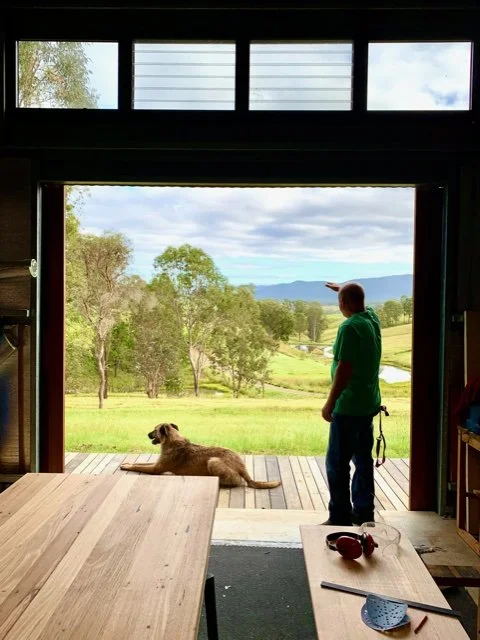
Image by Caitlin
AN ANTIDOTE TO EXHAUSTION
In Trevor’s loungeroom, a large photograph hangs above his hand-crafted credenza. It depicts an old furniture store in Berlin. Only the façade is left standing, with chairs now littered haphazardly around it. Shot by Trevor, this photograph is one of many of his own pieces of art in the home. Several world-wide adventures have seen him produce vast, powerfully contemplative landscapes. These, thematically, are an enquiry On Darkness, On Journey and On Transience amongst others. Pondering Trevor’s work, I’d mentioned a perennial kind of fatigue that I felt was blocking my own artistic practice, that I couldn’t wait for an upcoming month of overseas travel I’d booked to re-energise me. He gently recalled a story he’d heard poet David Whyte tell, “David tells of a regular meeting he would have with a wise old friend, a Benedictine Monk. And on this particular occasion, David was feeling absolutely exhausted as he greeted his friend at the door. As he ushered him inside David asked him straight out, ‘Brother David, tell me about exhaustion…’, to which Brother David replied, ‘The antidote to exhaustion is not necessarily rest.’ David Whyte responded, ‘The antidote to exhaustion is not necessarily rest. What is it then?’ Brother David says, ‘The antidote to exhaustion is wholeheartedness.’”
A story that has weighed on me since because what my version of living wholeheartedly looks like may be something I can only understand incrementally. Although I’ve made a change to my career, am I ‘living’ day-to-day doing what I love most, or do I now just have a more creative life on paper? I can choose to feel disheartened by questions like these, or use them to inform my next move…sitting comfortably with the fact that living wholeheartedly, for me, may be an everchanging notion, as much about journey as destination.
•••
RECOGNISING THE VALUE OF TIME
Recently I’ve read a touch of philosophy. In a year where a pandemic continues and war breaks out, the Stoics seemed like somewhere to turn to for perspective on my smaller problems. Although I’m sure it’s been shouted often enough from the Ted Talk stage, this time I heard clearly. And for some reason I needed to hear it from Seneca to realise that despite words like these having been spoken for thousands of years, society’s values still largely don’t accord. In c. 65 AD, in a letter to his friend, Seneca wrote:
“What man can you show me who places any value on his time, who reckons the worth of each day, who understands that he is dying daily?... Hold every hour in your grasp. Lay hold of today’s task, and you will not need to depend so much upon tomorrows. While we are postponing, life speeds by. Nothing…is ours, except time…What fools these mortals be! They allow the cheapest and most useless things, which can easily be replaced, to be charged in the reckoning, after they have acquired them; but they never regard themselves as in debt when they have received some of that precious commodity, - time! And yet time is the one loan which even a grateful recipient cannot repay…For, as our ancestors believed, it is too late to spare when you reach the dregs of the cask. Of that which remains at the bottom, the amount is slight, and the quality is vile.”
In the weeks after I leapt off my own ‘corporate hamster-wheel’, the change I made attracted others and creatively minded people told me about their side projects, about what they wished they were doing with their time instead of their employment. They asked what made me actually ‘change’. I kept relaying a version of Trevor’s story. So, in one way or another, this meandering essay of an interview, is putting pen to paper in an attempt to adequately answer that question. Although I’m not ‘there’ yet, still somewhat compromising, our threads of conversation have woven together to leave me with some certainty. My struggle to achieve work-life balance was always doomed because time is, for me, a ‘non-negotiable’—because every moment of time is simply life, and finite. Not a morbid thought, unless I find myself living as though it’s slipped my mind.

Image Provided by Trevor Neal
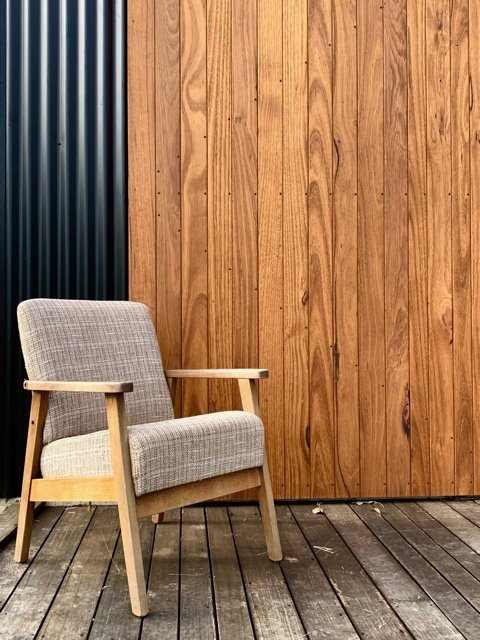
Image: Caitlin Leishman

ARTEMISIA GENTILESCHI’S WOMEN
Her legacy then is perhaps not depicting a new kind of woman at that time, even if it was new for the art world, but showing honestly the way women had always been.

Beheading of Holofernes, Artemisia Gentileschi
My mother gifted me a coffee table book, ‘Great Women Artists’. Each page a key work alongside a snippet about an artist’s life and oeuvre. A gory image of two women bracing themselves over a man they held down on a bed. One seemed to come over the top of him, pinning him down at the torso, while the other, eyebrows furrowed perhaps in both rage and concentration, was beheading the man with a large sword. The image is expressive and forceful, the painting precise. This is Judith (with her maid servant) beheading Holofernes. The artist was Artemisia Gentileschi.
Gentileschi (1593 – circa 1662) was an Italian Baroque painter. Her style, in its tenebrism, was influenced by Caravaggio, though her depictions are thought to exceed his in their naturalistic quality. She had a 40-year career at a time when female artists were scarce, and those taking on the ‘important’ subjects, like biblical and historical scenes, even more so. Yet Gentileschi, having trained with her father, had not only the skill to compete with her male counterparts, but in her depictions of women, she uniquely painted with insight, gusto and authenticity. Of her 57 well-known and attributed works, 49 feature a strong female protagonist, often in a moment of tension, hesitation or decision.
When she was 17 her father hired an artist, Agostini Tassi, to teach her drawing and perspective. Tassi came with a reputation of sexual aggressiveness and violence, so it’s odd that a father would invite him into his daughter’s life. Though Tassi’s potentially profitable connections such as Pope Paul V might explain Ozario Gentileschi’s incentive. Tassi raped Gentileschi. Seventeenth century law considered rape a matter that centred on whether virginity had been taken away. Even then, the seriousness of the crime was less about concern for the woman as it was for the depreciated monetary value she would be worth when being married off. So, Gentileschi’s father took Tassi to court and Gentileschi was tortured with thumbscrews when giving her testimony to discern truthfulness. She maintained her graphic version of events which have been preserved in the trial records that were exhibited at the National Gallery in London in 2020. This wasn’t the only trial she endured, she also lost two of her son’s during her life and her father and brothers are said to have been harsh with her. Gentileschi herself was also said to be violent. For instance, when a servant asked for payment, she and her husband beat him severely.
Whether or not her life’s challenges influenced her work is debated, especially in reference to her violent depiction Judith Beheading Holofernes. Holofernes was a general known for sexual violence, so some consider that she took revenge on Tassi through this work. As Siri Hustvedt notes in her essay A Woman Looking at Men Looking at Women, ‘How can art come from anything but life? The dead don’t make it.’ I’m not sure that Gentileschi used her art purely as a vessel for this rage, but rather as a resilient woman, perhaps she intended to depict women with a will of their own - women of the biblical stories as deliberate, calculating and determined in their actions with courage. Not the nonchalant puppets to a higher power that previously had been depicted. In Judith Beheading Holofernes the maid is participating, unique to Gentileschi’s interpretation, the women work in a kind of solidarity. Their sleeves are rolled up exposing strong arms and the process of beheading is labourious. The lines of the limbs draw the eye into the centre of the deed.

Mary Magdalene in Ecstasy, Artemisia Gentileshi
While women are often naked in Baroque and Renaissance works, Gentileschi reveals more about her protagonists in the way she has covered them. Works like Mary Magdalene in Ecstasy and Lucretia, pierce a window into the mind of the subject. In Mary Magdalene in Ecstasy the eroticism comes through in her tensed posture, contorted neck as her head throws back, the consumed facial expression. Her top may be about to slip from her shoulder, but it’s not required to convey a pool of electric bliss. Lucretia, a Roman heroine who was married, then captured and raped, kills herself to save her family from dishonour. Gentileschi’s version shows the moment as Lucretia is deciding whether or not to go through with it. Lucretia’s form is strong, she clutches her breast deliberately with one hand, a knife in the other. Her leg and decolletage only are revealed. With a severe expression she gazes above. It seems as though the questions of dishonour, power and will over oneself and body are more important to Gentileschi as the cause of the moment, than the act of suicide - the consequence.

Lucretia, Artemisia Gentileschi
Her talent was recognised and she was the first woman invited to the Academia del Disegno. This meant she could buy her own supplies and sign her own contracts without the permission of her husband. It meant independence. She was also awarded a commission to paint an altar which was symbolic of her reaching the pinnacle of a male-dominated mountain. Painting an altar meant she was considered a great artist worthy of painting for the most important and impressionable audience – the public.
Gentileschi did something different with her art, she conveyed women as they really were, not in the idealised form they were meant to aspire to. Her works didn’t simply depict an action from a historical scene – rather her talent captured emotion, thought and the complexities of women.
Despite being a woman in a man’s world, Gentileschi’s storytelling held her in high esteem in her day. Then we forgot about her for 300 years. This is thought to be because many art history scholars were men, writing about men, for men. Gentileschi came back into the public eye around 1970 as feminism heightened. Just like reading a newspaper, looking at art requires keeping in mind whose lens one is looking through. Just as we interpret art individually, so does each artist interpret life.
Gentileschi painted heroines of the bible and of history. She retold their stories with a new focus on the strength their actions would have required. Her works, rife with empathy, rage and power at a time when these women were often depicted tranquilly adorned with vacant expressions, as though posing - their courage act a pretence. Gentileschi made her protagonists actions real and their own, something new and visceral for the women of her day.
Her works have been described as a kind of feminist rebellion. Maybe, but I think she also did something more powerful - she corrected. She took a red pen to the work that came before her, margin notes explaining that this is what a real woman looks like, how she thinks, how she feels and how powerful she can be. Her legacy then is perhaps not depicting a new kind of woman at that time, even if it was new for the art world, but showing honestly the way women had always been.
In a documented letter from 1649 to a regular patron, Don Antonio Ruffo, she writes ‘With me your lordship you will not lose and you will find the spirit of Caesar in the soul of a woman…I’ll show you what a woman can do’
Though she apparently wrote these lines to justify her professional skill, each of her works seems to attest to her point - to show what a woman can do. Just as she was inspired by courageous historical heroines, perhaps she’s become one of them for the twenty-first century.
Then again, this is just speculation,
through a lens,
all of my own.

Folklore: The sui generis nature of a superstitious Iceland
Scientifically they are charged particles trapped in the Earth’s magnetic field. Mystically, they are the Northern lights. Iceland is a country where natural wonders are abundant. Volcanic islands sit on standby beside the mainland, remnants of lava formations create oddly rippled mountain ranges and blue lagoons beckon.
Scientifically they are charged particles trapped in the Earth’s magnetic field. Mystically, they are the Northern lights. Iceland is a country where natural wonders are abundant. Volcanic islands sit on standby beside the mainland, remnants of lava formations create oddly rippled mountain ranges and blue lagoons beckon.
Iceland is an ecosystem with a visible pulse and a bipolar personality. It is so unpredictable in its beauty and bizarreness that a seductive view can quickly become life threatening. In 2017 a tourist fell off a cliff while hiking in the notoriously gnarled highlands. Another tourist, in the same month, fell from a mountain after veering off the official track. Considering both its beauty and danger, it is a landscape that is so revered by its local people that it has been the ideal setting to breed belief in the supernatural. Uniquely, Icelandic supernatural beliefs are connected to environmental phenomena, rather than to people. This avoids the inhuman acts that superstition can otherwise cause between humans.
Since the twelfth century, Icelandic folklore has acted as a kind of mystical guide passed down to children so that they have the know-how to survive the treacherous environment. There are the Huldufólk (hidden people), who are elves that live like small invisible humans. Álfhól (small wooden churches) have been built over the countryside, so that an elf can be converted to Christianity should they wish. Trolls have morphed into stone pillars along the beaches of the mainland. Each supernatural being is related to an aspect of the landscape. Each story tells a child how to act around that land to avoid the danger of the creature, and therefore the danger of the environment itself. If you disturb the rock faces, you disturb the elves.
Although these tales are part of childhood education, the number of adults who continue to believe suggests that there’s something more to it. Roughly 50% of the population (according to National Geographic) believe in the folklore creatures, or believe they possibly exist and are wary of them…just in case. For example, the Gálgahraun Road construction team changed the direction of their construction to respect the wishes of elves. This was after several attempts to build close to the lava fields (said to house elves) resulted in inexplicable machinery breakages. Heeding the warnings, the construction team re-oriented and built elsewhere.
Icelandic folklore differs from superstition in that while both rely on a strong belief in the supernatural, folklore hinges itself on trust in the way the natural (and imagined) world works, while superstition requires irrational fear and ultimatums with oneself and between humans. Superstition is not about working with others, rather it’s about good and evil–and luck! There’s no learning or guaranteed outcome of superstition, simply a selfish and fearful reasoning to explain strange occurrences. Humans are a danger to each other when the fearful superstition drives violence.
The Salem Witch Trials resulted in 20 murders. They had been found guilty of witchcraft or aiding witchcraft. The hysteria began when two girls became deliriously ill. When a doctor couldn’t logically diagnose the cause of the illness, the people couldn’t find anything to reasonably blame–except each other. In this way superstitious fear is contagious during uncertainty. Even today China is a country steeped in traditional beliefs of supernatural methodology such as Feng Shui. However, the Chinese government recognized the powerful ability that superstition has to scare people, and cause them to break the law or harm others. They created a criminal law in 1979 to prevent the spread of superstition in the media.
Most adults feel comfortable debunking superstitions, and disbelieving fantastical creatures. Yet perhaps there is something to the peaceful equilibrium that a belief in folklore creates between the Icelandic population and their natural environment. By having creatures with personalities attached to elements of the land, it encourages sympathy and a wary respect from the human population.
The relationship between the Icelandic population and its folklore has proven to be sui generis, like no other in its attachment to the natural environment and in timelessness.

MI CASA ES SU CASA: Arranging a home and being comfortable sharing it
Rebecca is a story, written by Daphne du Maurier about a young woman who marries a rich older man and attempts to become the mistress of his mansion Manderley. Prior to this marriage, the older man, Mr De Winter, had had another wife. Rebecca was an extremely glamorous and vibrant woman.
Rebecca is a story, written by Daphne du Maurier about a young woman who marries a rich older man and attempts to become the mistress of his mansion Manderley. Prior to this marriage, the older man, Mr De Winter, had had another wife. Rebecca was an extremely glamorous and vibrant woman. As the new wife explores Manderley she begins to build an image of Rebecca through all the traces of her left behind in every part of the home, from the writing set initialed with R, to the paintings she commissioned and the azalea flowers she preferred. Certain rooms, such as her dressing room, are kept under lock and key, preserving Rebecca’s things in their precise state. Her comb lays idly, a dressing gown strewn elegantly across a bed, scented bottles assembled on a dresser waiting for slim hands to use them. Were it not for the inevitable mustiness of an unused room, the narrator believes that Rebecca could walk in at any moment and resume life. The young narrator struggles to make Manderley her own. Rebecca is irreplaceable and the roots are too deep. The intertwining of Rebecca with Manderley is so crucial to Rebecca’s power in this story that the young narrator, the new Mrs de Winter, is never named in the book. This story demonstrates how embedded an owner becomes in a home, that the attitudes and mood of a space grow alongside the personality of the person living in it. This reveals the way a guest instinctively investigates a home, drawing conclusions from little objects.
Although De Maurier wrote Rebecca in 1938, the notion that homes are more powerful and personable when they accurately embody the sentiments of their owner is now key to the interior design profession. From the dishes in the sink that are still ‘soaking’, to the books on the shelf or the trinkets that add a little randomness that peak a guest’s curiosity. These small things all create a picture of a unique lifestyle and energy that design principles alone cannot achieve.
Ilse Crawford is a British interior designer that approaches her practice in a very particular way. Crawford notes in the Netflix series Abstract that a designer must understand who they’re designing for. When working with clients, she considers that she has two ears, two eyes, and one mouth and that they should be used in that proportion. Observation and investigation guide the creation of spaces that, like Manderley, weave genuinely into the lives of their inhabitants.
Author Deborah Levy in her book, The Cost of Living, sums up the importance of this innate sentimental connection to the home. The book is a beautiful looking glass into how our lives unfold unpredictably in the spaces we live in and the comfort that our meaningful surroundings offer. She discusses moving home twice. Once as an adult where she describes being distressed at having found herself ‘unmaking the home (she’d) spent much of (her) life’s energy creating’. In the second instance she is 9 years old on a train from South Africa arriving into Waterloo Station. ‘Where were my clothes? My toys? Where was our stuff? The furniture from our family home?’ Her descriptions denote the feeling of security that treasured possessions provide to their owners, and their ability to give an understanding of identity. They may only be small things that children become attached to, but over the years we build upon them to create something that’s unique and difficult to pull apart and pack into cardboard boxes.
Being surrounded by small sentimental souvenirs that evoke memories can be reassuring. However, displaying sentimental items means there’s also a lot of yourself on show for your guests to investigate. Experiences and tokens that were previously hidden in personality-lacking IKEA drawers are now displayed. An exposed feeling emerges, where guests can see the dirty dishes that point to disorganization, or the books that suggest political, cultural and personal values, or the trinkets that, to the un-sentimental eye, seem like tacky bric-a-brac. The guest can peek into the ‘neuro-wirings’ of the inhabitant.
A heavy marble egg sits in a porcelain cup on a chiffonier in my parent’s home. It’s out of place to anyone other than us. Since childhood I’ve found the weight of it in my hand is comforting, alongside the fact that it was carefully selected, once upon a time, by my nana in an antique shop. Designer Axel Vandervoodt considers the home a reflection of the soul, therefore seeing these little possessions everyday is important. He encourages confidence because it’s difficult to relax in a home decorated for the person we want to be seen as, rather than for the person we actually are.
The interior design of a home is now not only reflective of the wellbeing and status, but also the soul of its owner. The gathering and displaying of items isn’t about being materialistic but rather stems from the same compulsion that some of us have to unpack a suitcase, hang a shirt or put jewelry on a bedside table. A compulsion to make a foreign destination feel even just a little more our own.
Creating a home is one thing. Sharing it, and the sense of life and identity that is dotted throughout it, is another. The trust and confidence required to feel comfortable putting a whole life of experiences on show isn’t automatically installed in all of us, no matter how extroverted one may be. Yet, each person welcomed into the home, and the intrigued comments they make, chips away at this vulnerability. Interior design in the home is an exercise in establishing a genuine identity, and being proud of it.