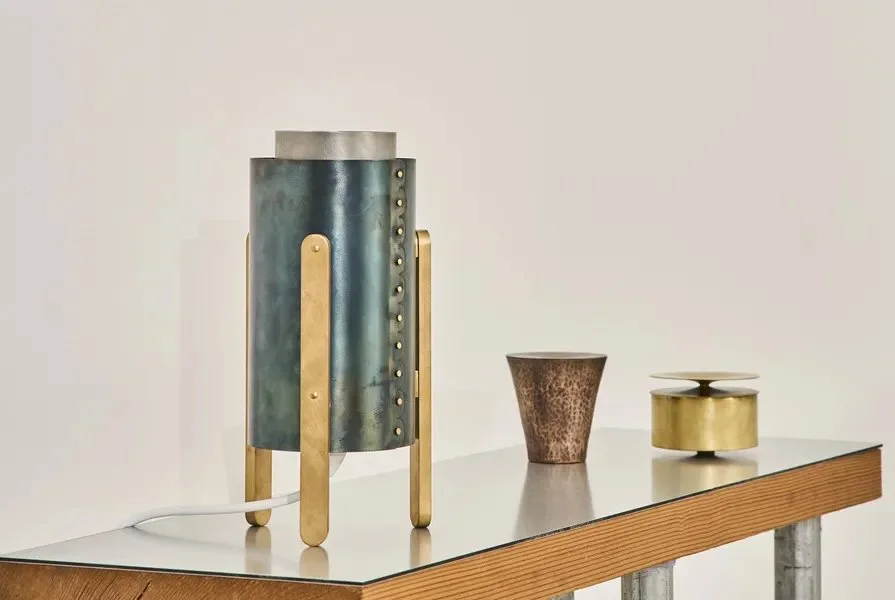
Lachlan Vasic for Interiors, Au
By embracing the expertise of others, Lachlan Vasic has crafted his own unique skillset and a body of exquisite works.
Image: by Claire Armstrong, Craft

Jess Humpston for Interiors, Au
Jess Humpston’s furniture: An ode to objects of single purpose
Jess Humpston’s timber designs extend an invitation to be used, and thus completed. In return? The bliss of interacting with objects that have been crafted precisely, yet beautifully, to do one thing truly well.
Photography: Jess Humpston

Amy Vidler for Interiors, Au
Elegance and materiality: The work of Amy Vidler
Through meditative diffusions and organic forms, Amy Vidler’s sculptural lights reveal the softer side of typically tough, structural materials.
Photography: Shannon Rose
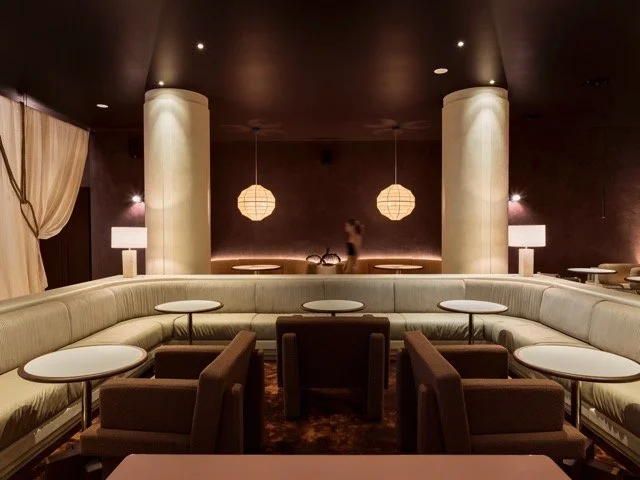
Interiors, AU: Sofitel Sydney Wentworth venues by FK
Culinary delights nestled within Australia’s renowned hotels need not be reserved only for travellers. House Made Hospitality’s four new venues at Sofitel Sydney Wentworth, designed by FK, provide elegant dining, bars and gathering spaces that invite the locals to linger too.

LEO: The first 90 years
The life story of Leo Christie OAM, covering the first 90 years in 30,000 insightful words.
"Without Caitlin‘s drive, patience and intelligent comments my story would never have been told."
Leo Christie’s life story brings together insights from his meandering and successful career, Greek heritage, enduring friendships and family life for an inspiring read that is brimming with wisdom. This document was developed with notes and resources provided by Leo, extensive interviews with him, and comprehensive research, before being edited and approved Leo.
Testimonial: "What started as a discussion after dinner one evening has turned into a lovely experience with Caitlin documenting my life story. On that evening my wife’s sister, brother-in-law, and Caitlin asked about my life, to which I spoke for about an hour and a half. To my surprise, my sister-in-law said, ‘You should document this Leo!' Subsequently, Caitlin helped me document my story. Over the years I had started to write notes about my history through various attempts. Caitlin flew from Melbourne to Sydney on several occasions to conduct further interviews and review the structure she had pieced together with my notes. During interviews my recollections were discussed expanded and thoroughly documented. Caitlin’s documentation of my story is very impressive and I have found this process a wonderful experience. I have remembered lots that thought I had forgotten: events worth mentioning that otherwise would have remained forgotten. I have very little knowledge of my father‘s past. I did not ask questions while he was with us. My advice to everyone would be to ask your parents or other living relatives questions about your family's past which will be forgotten unless documented. Without Caitlin‘s drive, patience and intelligent comments my story would never have been told.”
Leo’s life story was developed into a 60-page document detailing the first 90 years of his life, accompanied by relevant photography. If you have a life story you would like told, I have various approaches and can tailor the process to your needs and budget.

Interiors, AU: Walker Street Precinct
Brimming with elegant flair, four new venues, designed by Cox Architecture with H&E Architects, cultivate a culinary neighbourhood for North Sydney. Quoting British designer and restaurateur, Sir Terence Conran, Brooke Lloyd shared, “design is 98% common sense and 2% something really special. The 2% is what makes a design demonstrably better. We worked really hard on the 2% for these venues to create that magical feeling.”
Photography: Alec Bruce Mason

Self-portrait
Is the compact mirror a tool for keeping what we see in check, or checking in on how we see ourselves?
Many things occur in front of our eyes, yet we do not see them. Every month or so the skin sheds a scale and another cell takes its place. The body continually patches itself up — a conservator working 24/7 with the tiniest paintbrush. The compact mirror (of the pocket-sized variety that doesn’t bother with pressed powder) reflects this evolving body of work and the reflection poses a question: is the compact mirror a tool for keeping what we see in check, or checking in on how we see ourselves?
Mirrors are nothing new. Some of the first are said to have been crafted out of volcanic glass over 8000 years ago[1].
The compact mirror, however, was popularised in the early 1900s as a convenient sidekick to mass-manufactured makeup[2]. Enclosed in ornate metal casings these hand-held pieces could last a lifetime, before the introduction of plastic packaging saw the compact mirror turn from inherited relic to disposable junk. More recently the compact mirror has been sent down the stream of redundancy by smartphones. But to write it off entirely is to recognise only one function the little mirror has to offer. Its other purposes, today, are anything but superfluous.
In 8AD the poet Ovid published the story of Narcissus — a beautiful youth predicted to live a joyous life, so long as he never recognised himself[3]. While hunting, his thirst drives him to water. He comes across his reflection in a still pool and becomes besotted. But the reflection disappears if he tries to touch it, forever out of reach. Trapped by his own beauty, grief ravages his life. Traditionally, the cautionary tale perhaps hinted that we ought to tread carefully on the blurry line between self-reflection and self-absorption while glancing into any mirror, let alone a conveniently available compact.
Today, however, it’s so rarely just one reflection. Today, we’re perpetually shared, watched and visible. So often the eyes of others are the reflective surface. My childhood was spent in a dress-up box, gleefully in awe of the transformations I achieved. Then, a teenager in my first bikini, I was called Pamela Anderson by boys just as young and inexperienced. Despite the empowerment Anderson inspires today, at the time these spattered slurs were designed as something between flirtation and insult, and intent aside, they marked the arrival of a fully-fledged self-consciousness. The mirror reflected not what I could see, but what I thought others might uncover. The compact mirror became a tool for minute inspection of a chain of bodily events. It witnessed every acne pustule, hair of hirsutism, and the butterfly effects of hormonal treatments where one catalysed the need for another. Later, I realised I was plucking and preening in the hope of reaching a static physical state that is at odds with the nature of an ever-evolving body.
Enter today’s compact mirror. Its role marks the threshold between a private sense of self and social obligation. For anyone, but particularly those who enjoy the pleasure of playful self-expression, it’s likely that interactions with others will involve watching them make a snap judgement of you — am I emboldened or enviously threatened by this person? — they will ask themselves with a glance. As internal emotions slip and slide during these public moments, the compact mirror protects a private gaze and reassurance, beyond what a smartphone camera can offer: it’s something offline and un-shareable, a miniature shield.
Sometimes the worst critic appears in the compact mirror. Then what? If the body is changing anyway, why not adapt and mould with the tools at hand for those abundantly resourced? Filler, surgery, makeup. Why not bolster confidence? Perhaps the question is: to what end? Without an answer, the search for an enduring visual identity could feel like catching smoke. A compact mirror can aid, judgement-free, this personal decision-making.
Herald the intimate sanctuary the compact mirror offers, because sight isn’t a given, but a privilege and so is seeing oneself. Whether checking teeth for vivid specks of lipstick, or propping a knee on bended elbow to check out wonderous pleasure parts, to checking the tendrils of purple veins spidering over weightbearing shoulders …check, check, check. From Celine’s luxury to Charles Mallory’s frivolity and Chanel’s utility, given the chance, this humble tool holds gems beyond convenience. In today’s digital world where we’re our own PR agents, the compact can teach us as much about self-expression as grounding introspection.
Dig the compact mirror out from the back of the makeup bag, scrape off the flecks of crusty concealer and give it the renaissance it deserves. Keep it to hand. Swiftly flipped out of a slung bag in a spare second, it’s an ally. The compact mirror opens a portal that’s less about keeping the body in check, than checking in with it – inviting us to master our own self-portrait.
[1] Pub Med: History of mirrors dating back 8000 years
[2] American Popular Culture: About Face
[3] The Conversation: Who was Narcissus?

HABITUS LIVING MAGAZINE: #59 CORYMBIA
Subtle ceremony…Recurrent in Abernethy’s design is an inventive use of volume and double-height scales that deliver a unique rhythm. Oscillating between compression and expansion – through rich historical detailing and uplifting layers that build from cabinetry to window heights – the home eventually peaks where the rafters meet.
A Project Profile: March 2024
Architect: Karen Abernethy
Photography: Tom Ross
Traditional custodians: Wurundjeri People

HABITUS LIVING ONLINE: THE BEGUILING JOY OF ATONG ATEM’S PORTRAITURE
Atong Atem considers photographers cyborgs. “The camera becomes an extension of their body, movements, height, choice of angle.” The invitation and joy of her work, she surmises, comes from recognising the photographer’s intervention between what is captured and the truth of things.
Artist Profile: March 2022
Image: Atong Atem ‘A yellow dress, a bouquet 4‘, 2022, Art Gallery of New South Wales, La Prairie Art Award 2022 © Atong Atem

HABITUS LIVING ONLINE: MCPHAIL HOUSE
The design of a new extension at McPhail House doesn’t harshly define a beginning and end to the home’s chapters; rather it runs on its own harmonious continuum, along the connected interior views and sweeping curves of bespoke finishes.
A Project Profile: October 2023
Photography: Tatjana Plitt

I took for granted
I took for granted
The chair that carries me,
The chair that carries me,
ripped, worn and torn,
making space for that
which weighs on me.
This chair in the dust
of an unloved home
endures — just.
The same chair,
with the same
wear and tear,
in a loved space
pays tribute to
every bodily ache
and peaceful nap
it’s nursed.
My back reclines
into the nook you
keep indented
just for me.
Arms spoon mine
waist to thighs —
encased.
At ease up against
those there
for the long haul
bearing me with
unconditional embrace.

HABITUS LIVING ONLINE: KONINI KITCHEN
Aesthetically beautiful, Konini Kitchen has also been crafted with a humility that takes kindly to a little mess, a dish left on a bench, evidence of the movement and life that will see it wear authentically, bettered by every use.
A Project Profile: August 2023
Photography: Greta Van Der Star

HABITUS LIVING ONLINE: WARR FERRINGTON
Undisrupted views pass through Warr Ferrington, folding into one another.
A Project Profile: June 2023
Photography: Victor Vieaux
The Second Woman - Louise Mey, Translated from French by Louise Rogers Lalaurie
A psychological thriller that shows ‘just leave’ is hardly that simple. This book digs in under the skin and lodges itself in the gut – tying knots and clawing at the lungs, zapping the breath out of you.

Cover design by Louise Cand
This book digs in under the skin and lodges itself in the gut – tying knots and clawing at the lungs, zapping the breath out of you. This is why I’m not sure ‘recommend’ is the right word, but it is undoubtedly a powerful read. The Second Woman is an uncomfortable book to sit with because it gives a face and tone to something generally rendered invisible—hidden behind closed doors or in the yellowing of a mark on a cheek—domestic abuse. The story is told from inside Sandrine’s mind. There’s chaos in there, thoughts that disobey and climb their way aggressively to the front of the queue as she goes about her day-to-day ‘stupid, fat, ugly, bitch’ interjects like a car horn as she silently performs the most mundane rituals like making the morning coffee or doing washing. It’s almost as though the action of having these thoughts has become as much of a part of the ritual as her daily tasks. It is quickly clear that she is someone who does not like herself. Someone who has been told for some time now that she’s not worth it — she is the Second Woman.
The story starts in the present day when Sandrine’s partner is watching TV. His face is drained and gaunt because a woman, who has completely lost her memory, has appeared on the news, someone he thought had ‘disappeared’. The First Woman. As the story unfolds, we find out, detecting alongside police, what has happened to the First Woman. But Mey also delves into Sandrine’s life and history through her thought patterns, demonstrating how we can be held captive to thoughts that others planted in us, even from childhood. These thoughts give an impression of her life with her parents and the way freedom can also feel like despairing loneliness. When someone is abused at home in adulthood and isn’t being shackled physically, often people wonder why they don’t ‘just leave’. Mey unpicks why. The book layers emotional circumstances that cumulatively make leaving difficult. It shows how easily a mind can be moulded and how much it will sacrifice when it craves intimacy, love and security.
While this is fictional, Mey notes at the end of the novel that alarmingly ‘in the UK almost one in three women aged 16-59 will experience domestic abuse in her lifetime’. The Australian Institute of Health and Welfare data from 2016 states that 20% of the population reported ‘experiencing physical and/or sexual family and domestic violence since the age of 15.’ The figures for women are higher, and this statistic only reflects those who have reported it. Although there are significant doses of angst and cruelty throughout the book, and it does make you grateful for the little freedoms one might take for granted, this is also a story of resilience that shows just as you can fall easily into the hands of the wrong people, serendipitously it’s entirely possible to rebuild a life, albeit with scars, with good people. Trust isn’t a completely fruitless exercise; it’s just about having had the luck to establish self-confidence and self-love, before working out who is worthy of your trust.

HABITUS LIVING ONLINE: CYPRESS CREATES ELEGANT SPACES OUT OF THINK AIR
Cypreś exemplifies that creating quality space doesn’t rely on an expansive floorplan — far more important is an ability to rethink the structure of home in a way that makes use of spaces that would otherwise be lost.
A Project Profile: April 2023
Photography: Brock Beazley Photography
Changing over time
Some artists leave the womb with a compulsion to create, driven by necessity. It’s all they can do, and nothing else will do. For others the need to create isn’t as obvious but it emerges more gradually from a restlessness.
An interview with maker and artist Trevor Neal.

‘On Transients’, Artwork by Trevor Neal
WHAT TO DO?
I had a conversation with my dad, a school teacher who’d helped me navigate the ‘what-am-I-going-to-do-with-my-life?’ aspects of teenagehood. We sat in the garden of my childhood home —I’d returned for the weekend feeling antsy with the need to work it all out, the pressure of finishing university closing in. Crunch time. “Why not a retail manager?” he offered. And at that I lashed out. I was finishing a degree. Sure, I wasn’t as intelligent as the lawyer, banker big-time acquaintances that I’d been surrounded by at the University of Melbourne, but didn’t I need to be more? Ignorantly, I felt insulted. At some stage during my tirade, I drew breath and Dad had a chance to remind me how much I’d loved the retail work I’d done while studying. I had loved chatting to people about interesting things and objects in store, seeing some of them awkwardly shuffling, trying pieces on and shyly, peaking in mirrors, wondering what’s ‘them’, whether they dare. The golden moments were seeing them leave a little more confident in their own skin. Maybe derived initially from an outfit that made them feel that a little of something trapped inside had broken out, but it’s a feeling that had legs. I’d loved it. “We just want you to be happy,” Dad sighed. Insult turned into relief. But I still had no idea what I wanted to do. Was it retail I liked or something else it brought out in me? Rather than work out the answer for myself, I booked a series of sessions with a career advisor instead.
•••
THE CATALYST
Years and several jobs later I reconnected with our family friend Trevor Neal. As a child I’d perused Trevor’s home shamelessly. Full of art, ornaments, photography books and interesting pieces of furniture. Everything, just-so, came together in a naturally welcoming way. I’d ask questions. What’s this? Where’s it from? And everything had a story. Trevor had begun professional life as a teacher before embarking on a 14-year career that led him to senior management in the global pharmaceutical industry. But one day in 2012 he resigned and found himself running down the stairs of his Vienna office building. A weight seemed to lift, “Thank goodness that’s over.” At the time he thought he was referring to that particular piece of office life, later he realised he was feeling the release of saying goodbye to corporate life all together. He became a maker and artist, spaces he’d been forever tinkering in, though not devoted to. A budding art and design lover myself, I wanted to know all about his work. Through a meandering set of conversations spanning years, I worked out that it wasn’t just his work, but how he came to it — that was what I really wanted to understand. I was still looking for career advice. Or so I thought…
Upon returning to Australia, leaving corporate life behind, Trevor started his furniture business ‘More than Palatable’ —and he literally started with palettes. “I’d take the tram from Mooney Ponds Junction, where I was renting, up to Highpoint Bunnings, picking up an old palette and other rubbish. So, I’ve gone from this senior corporate role to being at the back of the tram surrounded by rubbish.” His first wheeled coffee table sold on Gumtree for $150. “I’d had vastly bigger pay cheques but never one that had been more satisfying,” he recalled. ‘More than Palatable’ grew utterly into its pun, as Trevor’s work was no longer about striving for a typically ‘palatable’ version of success.
A couple of months of email threads passed before I visited Trevor over a weekend in his home on the hills of Gloucester in NSW, where he lives with his partner. Merrick, a gentle giant of a wolfhound-kelpie cross keeps company, peering out from under his eyebrows, sticking to his owners like Velcro. In the living room of a morning, a ceiling-height timber, deco-style divider made by Trevor houses mementos within its nooks, while Melbourne duo Vika and Linda plays through an upcycled retro radio. “The things in my home are emblematic of my experiences and make the house a home, a place to belong. The furniture I make is an extension of this, functional for life while simultaneously reminders of journeys taken…it’s the nature of recycled materials,” he pinpoints as inspiration.
A little way down the hill, Trevor has built his 140sqm workshop; charcoal-painted steel with a timber deck and immense sliding timber doors, timber recycled from a Mornington Peninsula demolition. Inside a dining table is a work-in-progress. Crafted out of wood from Daylesford’s old Rex Cinema. The piece is an example of the way Trevor moulds materials into a new chapter.
•••

Credenza and artwork by Trevor Neal, image by Caitlin

Merrick outside Trevor’s workshop, image by Caitlin
AS UNEASE DEVELOPS INTO A SENSE OF SELF
Some artists leave the womb with a compulsion to create, driven by necessity. It’s all they can do, and nothing else will do. For others the need to create isn’t as obvious but it emerges more gradually from a restlessness. Describing this growing unease with my professional life to Trevor, he recalled author Stephen Covey’s theory: the feeling is a little like you’re playing a role in a script written by someone else.
Catching the late morning sun over the rolling hills of Gloucester, coffee in hand, lounging on the timber decking in seating that Trevor had handcrafted, I asked why we fear change and why it feels risky. In one email he’d discussed how his sense of self developed, as the years went on, he became aware of the institutions framing society and that often a sense of self develops either within or despite those surroundings, “For me, for as long as I could remember I had this feeling of not fitting. I did almost everything that my family, community, society asked and expected of me and always within myself I felt unfulfilled. My sense of self was not just eroded through participating in a life that wasn’t fully owned by me but even more so through the knowledge that I was allowing it to happen. On reflection, just about every institution I can name was stifling me.”
•••
DEFINING THE NON-NEGOTIABLE
Making a significant change to pursue a creative life takes guts, considering our bank accounts and the fact that we’re fundamentally connected to other people in life. Feeling these pressures, I put them to Trevor. “We all have to make decisions for ourselves in the context of the responsibilities we carry. If we were to wait for just the right conditions to come along, we would most likely never get the chance because we couldn’t ever take the chance. In my experience it’s not possible to have it all. Only the thing that is most important to you can ever be for certain. Everything else carries a value to be negotiated, including your commitment to living your own truth.” As someone easily (though gradually less so) influenced by others’ opinions of me, I pushed Trevor further. When you know you need to make a change, and you’re clear on what your non-negotiable is, how do you manage other people? In some ways Trevor could relate to my angst, “There were people who had an expectation of me that was purely related to their own needs…So for my own survival I had to say ‘I can’t carry the responsibility for your life’, and it’s a sad goodbye. But people of great value who love you for you — not what you do — find a way to come along. Those are friendships that go through transitions well because those friends need nothing from me.” He referenced a poem by David Whyte that he found comfort in, Sweet Darkness. A poem that made clear to me that authentically feeling like you belong can’t be faked.
During COVID-19 I had that moment, staring out the window, realising that what I was doing with a majority of my week wasn’t what I wanted to do for the next 40+ years, so I made my own change. Part-time work with dedicated week time for freelance writing. Some friends told me I was ‘brave’, but a friend who has known every version of me since childhood was awash with relief, telling me she’d never felt prouder of me. She wasn’t proud of something I was doing, rather she recognised that I was being more myself than ever.
•••

‘On Darkness’, Artwork by Trevor Neal
TO YIELD TO RISK OR UNCOVER COURAGE
When acquaintances asked me what I do (because we always ask that, what someone ‘does’ implying work, not what they’re interested in), and I explained my freelance arrangement, the word ‘brave’ continued to come up. The word ‘brave’ then started to niggle at me, heightening my sense of risk. I asked Trevor about how he views ‘risk’ in this context? “I think of risk having a negative connotation, of being fear laden. I learnt that some people aren’t capable of walking with you through big change and their responses are more about their own fears and anxieties. It can have a harmful effect on one’s sense of self because of one’s own heightened sense of vulnerability… Even commentary around being brave can be laced with similar meaning. That said, I’m more interested in courage because it’s fundamental to make your own journey. I also think one emanates more so from the mind, while the other is of the heart. A creative journey has to be mindful of both but I think by definition it tends to be heart-centric.”
When I think of heart-centric creatives, I think of the Patti Smiths of the world who came from nothing and unconventionally floated through phases of life instinctively before forging their very own, specific version of it. For some, being inspired by seemingly fearless artists, understanding the path they followed, can be a reassurance that creative life is possible. At least that’s how it felt for me, until Trevor, inadvertently, caused me to reconsider.
Early on in our emails I’d asked Trevor the age-old question flung at creatives– who are you inspired by? “Well, the ones I admire most are the ones we’ll never know the names of. Not a dollar to their name, but they are living their truth regardless. They get by, they own their life and accept full accountability for that life and they call themselves a … musician …because they are.” Trevor’s words took me back to an essay I’d read by Joan Didion, On Self Respect, where she argues that “character — the willingness to accept responsibility for one’s own life — is the source from which self-respect springs.” I later realised why I’d found Trevor’s response disconcerting, and why it changed the way I considered inspiration. It underlined that you can be inspired by others, but you can’t follow them. There is no map and no guarantees. Instead, courage and self-respect erode the need for them. A little light-bulb moment — we were no longer having a conversation about working, but about living.
•••
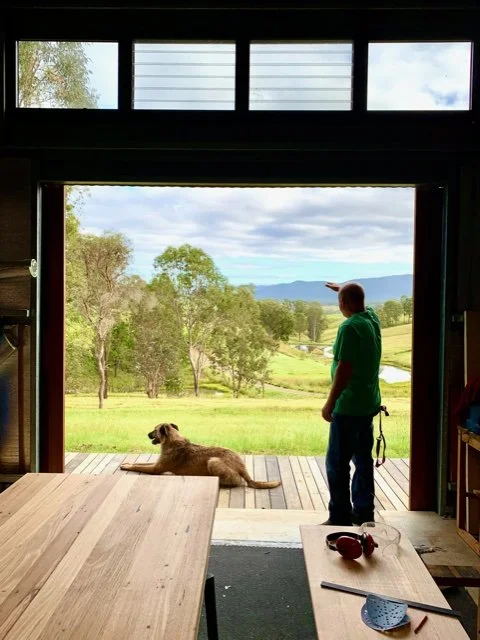
Image by Caitlin
AN ANTIDOTE TO EXHAUSTION
In Trevor’s loungeroom, a large photograph hangs above his hand-crafted credenza. It depicts an old furniture store in Berlin. Only the façade is left standing, with chairs now littered haphazardly around it. Shot by Trevor, this photograph is one of many of his own pieces of art in the home. Several world-wide adventures have seen him produce vast, powerfully contemplative landscapes. These, thematically, are an enquiry On Darkness, On Journey and On Transience amongst others. Pondering Trevor’s work, I’d mentioned a perennial kind of fatigue that I felt was blocking my own artistic practice, that I couldn’t wait for an upcoming month of overseas travel I’d booked to re-energise me. He gently recalled a story he’d heard poet David Whyte tell, “David tells of a regular meeting he would have with a wise old friend, a Benedictine Monk. And on this particular occasion, David was feeling absolutely exhausted as he greeted his friend at the door. As he ushered him inside David asked him straight out, ‘Brother David, tell me about exhaustion…’, to which Brother David replied, ‘The antidote to exhaustion is not necessarily rest.’ David Whyte responded, ‘The antidote to exhaustion is not necessarily rest. What is it then?’ Brother David says, ‘The antidote to exhaustion is wholeheartedness.’”
A story that has weighed on me since because what my version of living wholeheartedly looks like may be something I can only understand incrementally. Although I’ve made a change to my career, am I ‘living’ day-to-day doing what I love most, or do I now just have a more creative life on paper? I can choose to feel disheartened by questions like these, or use them to inform my next move…sitting comfortably with the fact that living wholeheartedly, for me, may be an everchanging notion, as much about journey as destination.
•••
RECOGNISING THE VALUE OF TIME
Recently I’ve read a touch of philosophy. In a year where a pandemic continues and war breaks out, the Stoics seemed like somewhere to turn to for perspective on my smaller problems. Although I’m sure it’s been shouted often enough from the Ted Talk stage, this time I heard clearly. And for some reason I needed to hear it from Seneca to realise that despite words like these having been spoken for thousands of years, society’s values still largely don’t accord. In c. 65 AD, in a letter to his friend, Seneca wrote:
“What man can you show me who places any value on his time, who reckons the worth of each day, who understands that he is dying daily?... Hold every hour in your grasp. Lay hold of today’s task, and you will not need to depend so much upon tomorrows. While we are postponing, life speeds by. Nothing…is ours, except time…What fools these mortals be! They allow the cheapest and most useless things, which can easily be replaced, to be charged in the reckoning, after they have acquired them; but they never regard themselves as in debt when they have received some of that precious commodity, - time! And yet time is the one loan which even a grateful recipient cannot repay…For, as our ancestors believed, it is too late to spare when you reach the dregs of the cask. Of that which remains at the bottom, the amount is slight, and the quality is vile.”
In the weeks after I leapt off my own ‘corporate hamster-wheel’, the change I made attracted others and creatively minded people told me about their side projects, about what they wished they were doing with their time instead of their employment. They asked what made me actually ‘change’. I kept relaying a version of Trevor’s story. So, in one way or another, this meandering essay of an interview, is putting pen to paper in an attempt to adequately answer that question. Although I’m not ‘there’ yet, still somewhat compromising, our threads of conversation have woven together to leave me with some certainty. My struggle to achieve work-life balance was always doomed because time is, for me, a ‘non-negotiable’—because every moment of time is simply life, and finite. Not a morbid thought, unless I find myself living as though it’s slipped my mind.

Image Provided by Trevor Neal
Image: Caitlin Leishman
TÁR: A story of rise, and fall
A woman changes her name, dons a uniform of exquisitely tailored suits and, with genuine talent, sheds her old skin in order to become a world-class conductor of the Berlin Philharmonic – to become Lydia Tár.

A woman changes her name, dons a uniform of exquisitely tailored suits and, with genuine talent, sheds her old skin in order to become a world-class conductor of the Berlin Philharmonic – to become Lydia Tár. The film opens with an audience in shadows, spotlight on Tár who is being interviewed on stage by The New Yorker’s Adam Gopnik. Gopnik begins with a monologue introduction, Tár is clearly a maestro, offering insights on what it is to hear music, when music really starts. The shot pans back to a silhouette of a woman’s ponytailed head, her assistant, mouthing Tár’s words. This interview too is a performance. It’s the first hint that alongside talent, the ‘maestro’ is just one of the many faces this character has. The film explores all of them. The good, the bad and the ugly. Cancel culture, power dynamics, exploitation, love, lust and whether art can be appreciated despite the flaws of an artist, are all investigated in this film which works in the blurry, grey areas. It doesn’t seem to give a clear opinion on these themes, just lays out a story that points to the not-so-straightforward nature of things.
The film is set in music. In this case, the elite nature of it, the politics of it and the sound of it. But sound seems to play another role. What made Tár great, the sound of music she could guide out of an orchestra, also haunts her — misophonia, an extreme sensitivity to sound that disrupts her sleep and impacts her psyche. Visually the film has electric moments, the fierce movements of musicians as they are eliciting powerful or suprisingly soft sounds from their instruments. At other times, silence is the backdrop to gloomy scenes of Berlin that have an eerie, anxiety-provoking affect — not unlike a Daphne Du Maurier novel.
Some have criticised the portrayal of a world-class female conductor being an unlikeable character — considering it’s tough enough for women as it is without the rare portrayals of those who make it to the top spots being unflattering. Why make Tár quite so awful? A fair question but one that also prompted me wonder why women can’t be brilliant and awful, yet admired, in the same way many white male artists have been? I guess she’s a protagonist, not a hero. Criticism that the film is anti—women is complex, and there’s probably no right answer here. A couple of factors I consider are that it’s one of the few films I’ve seen in a while where all of the leading roles are female (albeit not a terribly diverse group). Secondly, the Dresden Philharmonic participated — the actors in the orchestra are world-class musicians, as their talent couldn’t be faked. Perhaps this involvement by musicians contributes to a sensitivity reading of sorts, maybe, maybe not. In any case, the film is a provocative conversation starter…
After the film my partner and I spoke a lot about it, debated it, had a verbal relay of our different interpretations of particular scenes. We struggled — navigating ‘right’ and ‘wrong’ as we discussed, in a bid to find the politically correct or moral high ground on relevant issues raised. But here those issues are complicated, with characters playing in the space between right and wrong, through context. Cate Blanchett, Nina Hoss and Sophie Kauer, directed by Todd Field, wrapped me up in this nuanced story. I don’t know anything about acting, except that if I don’t notice it at all … it must be good.

HABITUS LIVING MAGAZINE #55: CURATED LAYERS
At Tropical Townhouse in southern Vietnam, the layering of simple materials has coalesced in an exquisite home.
A Project Profile: February 2022
Joan Didion: A unique sculptor of essays
I borrowed a bundle of books from a former colleague, the kind of sunny person who leaves David Sedaris’ ‘Naked’ on your desk. Her taste in other books was also very much to my liking. Yet, I returned them all…except one—a collection of works by Joan Didion. On the spine are the words ‘We tell ourselves stories in order to live.’

Caitlin Leishman: Interpretation of Juergen Teller’s Joan Didion Portrait for Céline campaign
I borrowed a bundle of books from a former colleague, the kind of sunny person who leaves David Sedaris’ ‘Naked’ on your desk. Her taste in other books was also very much to my liking. Yet, I returned them all…except one—a collection of works by Joan Didion. On the spine are the words ‘We tell ourselves stories in order to live.’
Didion’s subject matter might be mighty but her tone doesn’t get your attention by booming at you. Rather her voice makes her readers aware of things…quietly. Though piercingly. Her words have a habit of lulling me in, gradually creeping up and attaching until they suddenly elicit a visceral reaction, like a snake that seems to appear out of nowhere in one’s path, yet has been there the whole time.
Snakes appeared less metaphorically in her works. In the documentary ‘The center will not hold,’ she says this is because they should be avoided, but that to kill a snake is the same as having a snake. They’re still there. Echoing the snakes she avoided, her writing feels slick, elegant and all seeing, laced with warning.
When I consider the times in which she wrote and the subjects of her essays, think The White Album and Slouching towards Bethlehem, I’m reminded of Cookie Mueller’s ‘Swimming through Clear Water in a Pool Painted Black’ which documents quirky, chaotic, heart-wrenching moments of her life during the same era. However, where Mueller wrote from within her events, Didion seems to be writing from above the fray. It’s as though Didion is gazing upon a crystal ball, not wishing to change or predict events, simply waiting for the image to become clear. She waits, pen at the ready, to demystify the everyday disorder that we can’t make sense of ourselves. It might involve interviewing Linda Kasabian of the Manson murders, or unravelling her own personal grief.
Her ‘crystal ball’ is a notebook. Given her first by her mother as a girl, she was told to stop whining, to write it down, she explains in the documentary. The first story she wrote, at around five years-old, was of a woman freezing to death in the artic, who collapses and awakes, only to find herself dying of heat in the desert. And this from her child’s mind. Years continued, notebooks amassed, “see enough and write it down” became a method in itself. Then one day when she would sit down and have to write for work, on a day when the world seemed ‘bankrupt of wonder’, as she put it, she would have a notebook of observations that had ‘accumulated interest’.
At this point I should warn you that continuing on means reading slabs of Didion’s own words, because each of these are pieces of the jigsaw that I take away from her writing. To talk extensively about her writing and not include it seems unjust, though including too much, when you could just go and read her work, seems wasteful — so be it.
In the 1960s Didion ended up working at Vogue. Another writer was meant to submit a piece titled ‘Self Respect: its source, its power’. But the other writer’s words didn’t come, so Didion’s did. She wrote an essay far grittier than Vogue was known for —but they published it anyway.
What could have been a light pump-up piece on self-respect, instead leaves a reader examining the recesses of their mind. She begins,
“…Innocence ends when one is stripped of the delusion that one likes oneself.”
She frames self-respect as something that starts from a loss, then exposes behaviours that most commonly manifest in lieu of self-respect.
“The charms that work on others count for nothing in that devastatingly well-lit back alley where one heaps assignations with oneself: no winning smiles will do here, no prettily drawn lists of good intentions.”
It’s a passage highlighting the inevitability that that which has, so persistently (if unconsciously), been buried, will be stumbled upon.
Didion then tells us what it feels like, and from where in the void the choice to build it might be plucked.
“To live without self-respect is to lie awake some night, beyond the reach of warm milk, phenobarbital, and the sleeping hand on the coverlet, counting the sins of commission and omission, the trusts betrayed, the promises subtly broken, the gifts irrevocably wasted through sloth or cowardice, or carelessness. However long we post-pone it, we eventually lie down alone in that notoriously uncomfortable bed, the one we make ourselves. Whether or not we sleep in it depends, of course, on whether or not we respect ourselves.”
Self-respect now becomes not something one must earn, but something we can simply choose to possess, in spite of imperfection. Considering the fallible but fabulous Jordan Baker of Fitzgerald’s The Great Gatsby, she points out that,
“…people with self-respect have the courage of their mistakes. They know the price of things. If they choose to commit adultery, they do not go running, in an access of bad conscience, to receive absolution from wronged parties…in brief, people with self-respect exhibit a certain toughness, a kind of moral nerve; they display what was once called character, a quality which although approved in the abstract, sometimes loses ground to other, more instantly negotiable virtues.” She clarifies ‘character — the willingness to accept responsibility for one’s own life —is the source from which self-respect springs.’
By now, this elusive thing, self-respect, has taken on a kind of shape, and so too does the negative space around it, which makes up a forlorn sort of image that can only be what a lack of self-respect might look like.
“It was once suggested to me that as an antidote to crying, I put my head in a paper bag.”
With this inelegant picture in mind, Didion hints that the romance of sadness might be something that some of us find tempting. That during shitty times there’s a certain self-indulgence in imagining a soft flattering light upon tears, that one’s despair might, at least, be graceful.
Didion ends with a warning of sorts…
“It is the phenomenon sometimes called ‘alienation from self’. In its advanced stages, we no longer answer the telephone, because someone might want something; that we could say no without drowning in self-reproach is an idea alien to this game. Every encounter demands too much, tears the nerves, drains the will, and the spectre of something as small as an unanswered letter arouses such disproportionate guilt that one’s sanity becomes an object of speculation among one’s acquaintances. To assign unanswered letters their proper weight, to free us from the expectations of others, to give us back to ourselves — there lies the great, the singular power of self-respect. Without it, one eventually discovers the final turn of the screw: one runs away to find oneself, and finds no one at home.”
I interpret this as a far more eloquent approach to articulating that virtue of occasionally being able to say to ourselves, ‘well… fuck it,’ and move on. But this is only my guess. Her article on self-respect does everything but tell you how to get some. This isn’t her business. As in any of her works I’ve read, she observes, questions assumptions, but never preaches.
Didion died of Parkinson’s disease in December 2021. To write as powerfully she did she lived with a certain sternness. In ‘The center will not hold’ she recalled, at the height of the Woodstock era, getting a request to go to an apartment, someone she knew had something she had to see, and to write about. A small toddler sat on the floor of the room. A normal child, except for the white lipstick. It was on acid. Didion described it as ‘gold’, though her eyes upon recalling it, welling up, highlight that shock remains a key ingredient to stories that stick around in the mind. Rationalising the harsher side of journalism. But she did inflict this journalistic scrutiny on herself too.
“You write your material, you used what you had” she says of writing about her contemplations of divorce while on holiday, an article edited in fact by her husband.
Reading Didion’s work is like sitting down and having an honest and disarming conversation with someone about how things really are. Her words, like a renaissance marble sculptor, seem to chip away at the mass of an outer shell, revealing and leaving only what’s left at the core.

HABITUS LIVING ONLINE: LIVING BETWEEN PAST AND PRESENT
Navigating the realms of public and private, indoor and outdoor and past and present, Drill Hall House delivers a peaceful oasis where the best of all worlds coalesce.
A Project Profile: January 2022
Photography: Justin Alexander