
LEO: The first 90 years
The life story of Leo Christie OAM, covering the first 90 years in 30,000 insightful words.
"Without Caitlin‘s drive, patience and intelligent comments my story would never have been told."
Leo Christie’s life story brings together insights from his meandering and successful career, Greek heritage, enduring friendships and family life for an inspiring read that is brimming with wisdom. This document was developed with notes and resources provided by Leo, extensive interviews with him, and comprehensive research, before being edited and approved Leo.
Testimonial: "What started as a discussion after dinner one evening has turned into a lovely experience with Caitlin documenting my life story. On that evening my wife’s sister, brother-in-law, and Caitlin asked about my life, to which I spoke for about an hour and a half. To my surprise, my sister-in-law said, ‘You should document this Leo!' Subsequently, Caitlin helped me document my story. Over the years I had started to write notes about my history through various attempts. Caitlin flew from Melbourne to Sydney on several occasions to conduct further interviews and review the structure she had pieced together with my notes. During interviews my recollections were discussed expanded and thoroughly documented. Caitlin’s documentation of my story is very impressive and I have found this process a wonderful experience. I have remembered lots that thought I had forgotten: events worth mentioning that otherwise would have remained forgotten. I have very little knowledge of my father‘s past. I did not ask questions while he was with us. My advice to everyone would be to ask your parents or other living relatives questions about your family's past which will be forgotten unless documented. Without Caitlin‘s drive, patience and intelligent comments my story would never have been told.”
Leo’s life story was developed into a 60-page document detailing the first 90 years of his life, accompanied by relevant photography. If you have a life story you would like told, I have various approaches and can tailor the process to your needs and budget.

Zagara: A wistful scent on the cusp of jubilation
‘A garden for the blind.’ This is how Don Fabrizio Corbera, the Prince of Salina, describes his backyard.


‘A garden for the blind.’ This is how Don Fabrizio Corbera, the Prince of Salina, describes his backyard. The Prince is the protagonist in Giuseppe di Lampedusa’s novel, The Leopard. In this moment the Prince is surrounded by roses, magnolias, lemon myrtle, mint, and orange blossom wafts from a grove somewhere in the distance. The Prince’s stroll is a ruminative one, weighed down by overwhelming aromas and memories. Citrus notes remind him of having witnessed a fatally-wounded soldier use his last breaths to crawl into a lemon grove. Because in all its Sicilian beauty, The Leopard is set during a time of civil war and revolution. The nineteenth century, where the aristocracy will come to be replaced by new money. As the Prince brushes past Elysian scents, he is already nostalgic for that which has not, quite yet, been taken away.
I read this scene after spending an afternoon sniffing scents in a little shop-front. I came out with Santa Maria Novella’s Zagara Cologne. Opened in 1612, Santa Maria Novella is an Italian apothecary pharmacy specialising in complex fusions steeped in ancient remedies. Zagara is a Chypre-type fragrance where addictive floral citrus, jasmine, bergamot and blossom notes float in a fresh sweetness bound by woody oakmoss. The Prince’s Sicilian garden bottled in all its glory, complete with an ephemeral veil of melancholia.

About Time
We lose it, manage it, save it, waste it, then wish we had more of it. Time has become a kind of slippery, anxiety inducing method of measuring life, constantly grappled with.
The Persistence of Memory, Salvador Dali
We lose it, manage it, save it, waste it, then wish we had more of it. Time has become a kind of slippery, anxiety inducing method of measuring life, constantly grappled with. Way back when, time passing was marked by natural cycles. The sun rose and set on a see-saw with the moon gently, informing wake and relax. Today, unless one is orbiting a blackhole or hanging out with Elon on Mars, the need to closely eye the time like a sad day-trader monitoring their stocks comes from an unhealthy and misguided impulse that something important will be missed. The opposite is true. Second by second, rung by rung, the day-to-day becomes a hamster wheel, incessantly running to the tune of iCalendar alerts. Although most of the world rely upon them, schedules are little prisons for impromptu opportunities.
In Netflix’s Inside Bill’s Brain: Decoding Bill Gates, Bill’s assistant remarks that despite his wealth and intellect, time is the one thing that Bill can’t accumulate more of. It’s the one thing that he must use as wisely as the rest of we plebs. Some say time is money – but this thought triggers a dubious little whisper, warning that a life led as such is a constant blackmailing of oneself. Although not monetary, time is a kind of currency for life and it’s inevitable that it will be spent.
What is left after time? Memories. By examining memories one can measure the return on investment of a certain way of life. And value won’t be weighed according to one’s aptitude for time-management or efficiency. Unlike time, memories can be accumulated and if observed, the good ones inform how time should be invested in future. And when we die, it’s the warm memories created bit by bit with others that morph time past into tangible treasures that live on in others.
Albert Einstein said, ‘Time and space are modes by which we think, not conditions in which we live.’
Getting caught in the web of plans, routines and expectations is a choice, not something dictated by time itself. Time moulds to the parameters placed on it.
A watch is aptly named for literally observing time pass by. Surely, there are better ways to own it. Better ways to fill a treasure chest.

You'll have to speak up for Owen
This strained choreography continued agonisingly. His efforts seemed risky with the air thick and rain threatening. Each book, one at a time.
Walking back to the car I came across an elderly man laying books on a blanket on the corner of Brunswick St. A few creative types hovered. The man would pick a book from his wheelie walker, consider it carefully categorising it in his mind, then take an age to shuffle to the right spot on the mat and crank his rickety knees down to position it just so. This strained choreography continued agonisingly. His efforts seemed risky with the air thick and rain threatening. Each book, one at a time.
As I closed in a musty scent reached me, old books. The man was thin and a tattered suit hung from him. His pants were loose around his disintegrating waist, belted to the extent that the fabric buckled, overlapping the way it does when men lose strength, muscle and beer belly. Pants reminiscent of a livelier self. His fly wasn’t done up, though I’m not sure that this was a wardrobe malfunction, rather I just don’t think these pants did that anymore.
The skin on his face seemed a little alive; lumps and ravines morphing to their own agenda. His chin, forehead and nose thick as an elephant’s hide, yet only a veil of translucent skin held in his cheekbones.
He wasn’t talking to anyone, just going about his cataloguing.
He pulled out a range of books and genres one by one. Edgar Allen Poe’s poetry, Brecht’s philosophy, Albert Camus in French, Calavino in Italian, were woven in amongst Shakespeare, Murakami, Orhan Pamuk, Primo Levi, Daphne De Maurier and physics guides. Cantilevering myself over the mat I surveyed this mini library of his mind.
I picked up a book almost guiltily as I knew he’d have to find just the right substitute for the gap I’d left. Albert Camus – time revive my French. There wasn’t a lot of chatter and it was hard to navigate his purchasing system. I asked whether the books were for sale. Nothing. He just kept walking. I tried a woman nearby sitting on a bench flicking through a guide to Da Vinci’s art confidently. She responded matter-of-factly,
‘Yep, prices on the inside of the cover - but Owen is deaf – you’ll need to speak up!’
I took Camus back to Owen and positioned myself squarely in his path; between wheelie walker and mat.
I showed him the five dollars of coinage I’d scraped from the bottom of my bag and pointed to the grey lead $5 in the cover, offering to buy it. His brow gathered at its centre.
‘It’s in French!’ he was quick to point out. I explained with exaggerated nods of my head that I was aware and keen to practice. He flicked his head to the side unconvinced, but took my dollars.
After our odd transaction I hung about a little longer. I had a burning question. These books, all laid out, owned by this man who didn’t converse much, painted some kind of intimate portrait of who he might have been before he became too thin for his pants – so why was he offloading them?
Did he need money? Evidently. Or was he simply happy to cull some of his collection and share some knowledge? Maybe…Or was his health deteriorating like his attire?
When one isn’t properly educated across languages, conversing with someone who is hearing impaired means doing so loudly, insensitively.
It wasn’t a question I could bring myself to ask in the middle of a busy Brunswick St.
As I walked away, I flicked through the Camus I’d purchased and noticed penned English in a neat scrawl sporadically above obscure French. But the translations only lasted a few pages. Maybe Owen didn’t think I’d conquer Camus either.

An invite to breakfast
As though I’d crossed an invisible threshold and been sucked into another world…I was shopping in a life-sized doll house.
As a nineteen-year-old in Paris I decided to visit the Porte de Clignancourt Market. Reviews insisted on starting at the crack of dawn to avoid market mayhem, and considering I was the only one of our travelling party with a flea market addiction, it was a solo mission.
I got off the underground and found myself in a gloomy tunnel under an enormous bypass. A group of hooded teenagers were blocking my path ahead. Feeling edgy, I crossed over the road and walked on the heels of a German family. People with kids are meant to be safe right?
The suburbs of Paris aren’t quite as well-kept as the inner centre-ville. There’s a gritty resilience to the worn-out buildings. Hesitantly, I walked towards the only hint of market I could see, a stall with clothes hanging from its roof. As I reached the stall the full hustle and bustle of the market revealed itself and engulfed me, as though I’d crossed an invisible threshold and been sucked into another world. I resigned myself to the fact that I was going to get a bit lost at some stage, and would have to awkwardly ask for directions, and thus the a-la local Parisian exterior that I’d worked so hard to mould would crumble. The labyrinth of stalls interwove infinitely like a surreal Escher drawing. Antiques and plush trinkets covered every surface. At the centre of the market was a little green structure with mezzanines and squashed little shelves of treasures. I was shopping in a life-sized dollhouse.
At one of the thousand stalls I found a beautiful hand-made bag. I lifted the bag gently, waiting for the stall owner to come by so I could have a proper look, without appearing a thief. The owner came up to me and enquired whether I wanted to open the bag and check the lining. He was an attractive dark-haired 40-year-old man, who I imagined had an appreciation for the craft he was selling, and a lifetime spent in large workshops à la campagne, patiently making beautiful things with his hands - a genuine artisan. He was benevolent and patient with me, and I was enjoying practicing my French.
Then - he invited me to breakfast.
He said he knew a place not far from here. It seemed like a kind, though perhaps loaded…offer. I also was confused as to why a businessman wanted to leave the stall just as the busiest part of the week was approaching.
A woman stood a metre or so away from me, holding a bag. With a hard glare, her foot tapping and sporadic glances at her watch - it was clear that she was waiting expectantly to be served. Yet, the man paid her no attention. My vision of this handsome, kind, artisanal gentleman began to blur a little at the edges. Why wasn’t he trying to sell? The woman blurted out something to him in French and he replied in a terse tone - she tossed the bag down and, disgruntled, she left.
With that my rose-coloured glasses lifted entirely. He had nothing to do with this stall, he was just speaking to me as a stranger. Without socially acceptable context he’d slipped, like a chameleon, into my day. He was offering me breakfast and polite conversation. But that kind of trust hasn’t existed since the invention of mobile phones. My millennial mind has been trained to be sceptical, and his kindness began to morph into creepiness. I felt vexed at this shattering of my Audrey Hepburn in Roman Holiday moment. I summoned my most assertive French tone to politely (or not so much) decline, explaining that I’d eaten.
As I was considering my next move a older man with fluffy white-haired appeared. He grunted at us and went to stand towards the back of the stall. He waved me forward to the till and muttered a price. Now this was the behaviour of someone who had been selling these bags for a lifetime, whose passion ran out 50 years ago and who now conducts his transactions with the effort and emotion of a sloth. Although his boredom seemed contagious, I latched onto him. I continued to converse with him despite his silence and turned my back on my offer of second breakfast. Eventually my handsome ‘friend’ retreated, and I tentatively left the stall.
At the end of the path I saw my stranger had moved onto a young girl with an American accent who replied with loud giggles and phrase book French. I lingered, sensing that I should do something - but what? ‘Watch out for this guy - he’s offering breakfast!’
I was still locked in place when four other American girls, clearly her friends, came out from behind a wall of clothes and whisked her away on a flurry of high-pitched giggles. They walked together one way and the man another. I felt relieved, not because the girl was ok, but somehow seeing him speaking to her seemed to validate my curt treatment of him.
It was just an invite to breakfast.
He was kind, inquisitive and not offensive or threatening in any explicit way and yet…my gut went into fight-or -flight mode. Maybe because women my age have been taught to keep our guards up, stay in our own little bubbles - wear ear pods on trains, whether we’re listening to anything or not. It’s likely my instincts were right.
Though if we habitually suspect ulterior motives, we forfeit the possibility of stumbling across and recognising spontaneous and sincere kindness.
************************************
He’d lived in Paris, supposedly the city of love, his whole life. He was in his early thirties and despite his good looks he was aware that genetics had him ageing rapidly - he’d even been mistaken for forty before! Time was getting away, but mostly he was lonely.
His friends were all coupled up. They said he’d find someone. He just needed to be more open, confident and approachable, all those things that friends, well-intentionally, say that make you want to jump off a tall building.
It was market day in his worn yet homely suburb. His grandfather used to labour over his leather bags, toiling away to craft them by hand. He’d then sell them, but only to those who truly fell in love with and would treasure them. Sadly, decades of tourists trying to whittle down the price of bags that he’d poured his heart, soul - and literally - sweat into, had diminished his passion for the craft.
That day the man saw a girl standing by his grandfather’s stall. Perhaps in her early twenties, young - but not too young. Whether she could be interested in him or not, was one thing - the way she was looking over one of his grandfather’s bags, was another. She almost patted it - really feeling the leather properly and following the patterns with her finger. He wanted to talk to someone who could be this interested in his family history.
He walked over and started to speak with her - not French - though she could speak it, just enough. They chatted about the bag, what she liked about it, and about Paris. She seemed like a curious person, interested in things. He wanted to know about her. He liked her.
He mustered his courage and asked her if she’d like to have coffee with him at a place nearby.
She bluntly turned him down, just has his grandfather returned. Humiliated, he left.
On his way out an American girl asked for directions. He tried to explain to her, but his English wasn’t good enough and he’d had enough embarrassment for one morning.

The Hug
Flakes of red get caught in the deep ravines of her upper lip…
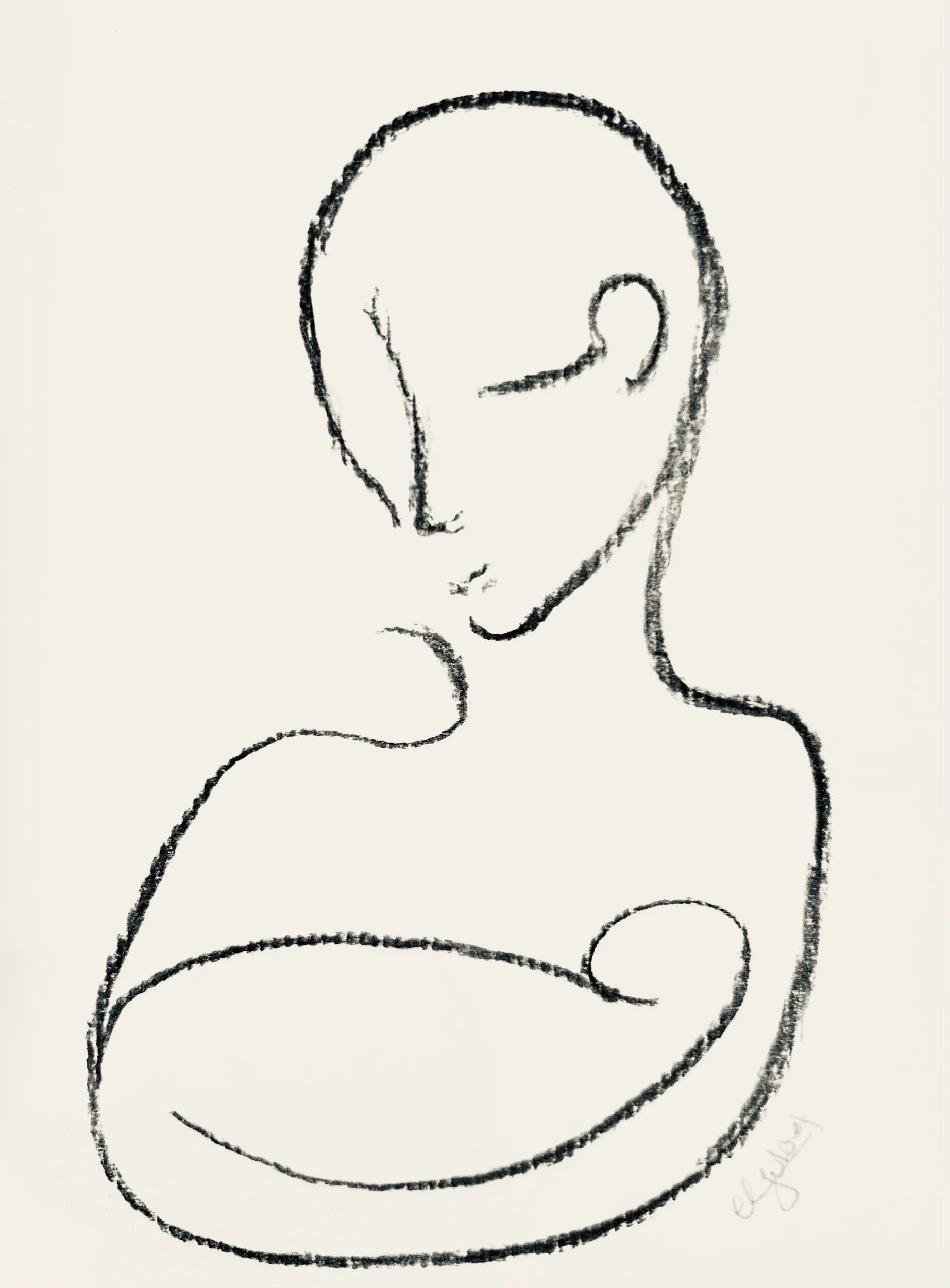
Caitlin Leishman: 2020 Pencil and pen on paper
Flakes of red get caught in the deep ravines of her upper lip as her shaky hands ritualistically drive a bullet of lipstick across them. A carriage over cobblestones. The wings of her eyeliner, still elegant, are a touch wonky these days, distorted by the wrinkled folds of eyelids that have slowly begun to encroach upon her view of the world. A potent fragrance dabbed, warns of an imminent and overzealous embrace to be bestowed upon them–which they must, if begrudgingly, accept. It’s a scent that for the first twenty years of their lives they will associate with love-tinted tedium. For the next twenty and beyond, halted by the smell of a passer-by or the warmth of a knit, in the absence of the hug itself, will be unparalleled nostalgia.
An ode to bedtime stories
In my bedtime stories, I was the Secretary General of the United Nations.
In my bedtime stories I was the Secretary General of the United Nations. These stories painted me as strong, elegant and supremely intelligent, though empathetic in my conduct. Think Cate Blanchett. So, in my 9-year-old mind, it didn’t seem to matter that I didn’t know what the Secretary General of the UN was, or did. I knew how I needed to act.
These ambitious bedtime stories were the invention of our family friend Facey. True to her name she was expressive and articulated with the sarcastic and quick-witted prose of a cheerier Helen Garner. Charismatically, as though on stage, she’d routinely shout - ‘DICKENS!’ - whether or not anyone had asked for a reading recommendation. For Facey, Dickens could solve most issues. If politicians spoke rubbish on TV - Facey insisted, they could be bought back to reality by a dose of Dickens. If kids played up at the high school, a detention with Dickens would do the trick.
In her storytelling, Facey drew inspiration from the classics. She’d start with three bears and a curly-haired girl, but soon enough I appeared in front of an assembly, negotiating world peace and providing security for all. The stories flattered me, almost as much as the fact that she bothered to spend time with a 9-year-old. As I dozed off, I’d feel proud and capable, my dreams brimming with possibility.
Curious about my path to success, I spoke to my Dad, who was conveniently the High School careers leader in our tiny town.
“What do I need to do to become Secretary General of the United Nations?”
He peered at me over the top of his little glasses that sat on the end of his long nose.
“As in, is there a Secretary General of the United Nations course? It doesn’t quite work like that Caito. You might look at studying Politics first, then International politics, and then become a Government Official, then a Diplomat or something.”
Doubt set in.
Until then I’d been surrounded by professions that had their task clearly in their title. A teacher teaches, a publican runs the pub, a nurse nurses, a checkout chick works behind a checkout. What started with the Secretary General of the UN, was an introduction to a world of mysteriously titled professions.
At university I dipped my toe into International Politics alongside a young man who went to the same college as me. I attended every lecture and tutorial, read every reading, made notes and planned my essays diligently. He sauntered into tutorials late, and only when he had to attend having used up all his free passes. He’d outwit the tutor and never failed to win a debate (or start one) despite having done no preparation for class. He handed in essays in their first draft, paper crumpled and coffee stained, a stream of thought that was nevertheless a convincing manifesto. He aced the subject. I, to say the least, did not! The realisation that good notes didn’t guarantee success in politics, bought my political career to a swift close.
More recently I was reminded of my bedtime stories. The Economist interviewed Secretary General Guterres, about whether the United Nations as an organisation still works. Guterres emphasised the organisations successful efforts with humanitarian aid but agreed, more diplomatically, that it’s tricky to provide world security when two superpowers like China and America won’t play nice, as Russia looms in the shadows waiting to pounce. I can’t say I envy his role.
I didn’t become Secretary General of the UN, but I have read more Dickens. In fact, I read every night before I go to sleep. The stresses of COVID 19 are no doubt seeping into the dreams of many adults, but children also absorb the symptoms of their parents stresses. The bedtime story is a small window for a young person to be inspired, to be reminded that they’re not alone, and for them to slip from that encouraging reassurance into their dreams. Yet perhaps bedtime stories can do adults just as much good as children in the current climate. This moment when the day has ended, but before eyes are shut, is a chance to set the scene for sweeter dreams regardless of age.
Here’s to Facey - lover of Dickens and master of the bedtime story.
To every adolescent error
You’ll be told to say hello to everyone
look them in the eye,
Smiling at a small community - earn your place.
But please don’t tell them everything,
just in case.
You’ll be told to say hello to everyone
look them in the eye,
Smiling at a small community - earn your place.
But please don’t tell them everything,
just in case.
There’ll come a time,
When the whispers will make you cry,
When gossip will flow through the grapevine,
And of course you’ll lie.
Clinging to approval of family and friends,
you’ll scramble to save face.
Your moment will no longer be yours,
As its truth you’ll deny.
And with each lost moment,
you’ll become acutely self-aware,
Doubting your identity,
The one being crippled by community.
Although they’ll eventually forget, for longer
you’ll carry some shame.
Perhaps in years to come,
Of these little blackmails,
You’ll still care.
And it will be you,
Who needs to forgive,
the small place from which you came.

Caitlin Leishman
Blue
A million years to form, a blue sapphire takes a fingerprint
from the meta-rock around it, while the titanium seeps in.
A million years to form, a blue sapphire takes a fingerprint
from the meta-rock around it, while the titanium seeps in.
I n Egypt, ground down lapis lazuli became the first blue pigment,
for art, for makeup, for the elite. Symbolizing those who win.
Tinctoria, just a crop that overgrew in fields of green,
yet the true source of indigo,
the dye for blue jeans.
Ultramarinus, beyond the sea.
With its special method of absorbing light rays,
a rainbow boils down to one degree,
only blue expansiveness.
A ship in the ‘olden’ days, after losing a crewman,
flew a blue flag as it returned to shore.
Today it’s called feeling blue, but human.
When the thrill is gone.
Painted ceramics, a trick of the eye, B.B. King,
a glance down at the sapphire my grandmother left me.
Perhaps it’s just my two blue irises, tinting my view of these things.

France 2018: Caitlin Leishman
A loose thread
It’s not so much that the thread is loose… it’s the weighing potential for it to completely unravel. And it’s not only that it could unravel, but that it could do so at an uncontrollable moment, poking a hole in your somewhat crafted self-assurance. Leaving it flailing.

Geelong Bay: Caitlin Leishman
It’s not so much that the thread is loose… it’s the weighing potential for it to completely unravel. And it’s not only that it could unravel, but that it could do so at an uncontrollable moment, poking a hole in your somewhat crafted self-assurance. Leaving it flailing.
So, it’s got to be done now, preferably yesterday, with needle and thread. A Sicilian seamstress deftly pricks and dips needle through lace like a daddy long legs repairing a web, the tools and rhythm an extension of their hands. Other, less experienced fingers believe that the tighter a needle is gripped, the more accurate the stitch will be…
…the folds of fabric, thicker than the needle chosen, tense under the pressure of a forced stitch, sending a warning of little sharp pains at the back of the neck. Tunnel vision prevents any pause or reflection.
The space between the nail and the top of the finger, at the threshold where the nail turns from white to pink, in there is where a slipped needle can spark mini bonfires of pain through the whole finger. It’s hard to get the blood out from under there.
Rinsing and scrubbing the blood out… Did your comment offend someone? Desperate for relevance, did you speak too much about yourself?...Glance up and notice a new pimple, leaning in pushing, and testing it with a little resignation, a little indecision. Incessantly picking at the delicate skin. Now there’s blood on your face. Pin-pricked.
From under embarrassment emerges a new image of oneself. Bathroom mirrors are functional things, but the space about a foot from them, where you plant your feet close to the basin, is one of the more exposing spaces we put ourselves in regularly. Turning them into our own Dorian Gray-like self-portraits.
The stitching is uneven but strong, and the pain in the finger bearable - but shame lingers.
Sometimes it takes more than a few stitches, more fortitude than is available to re-tune the sensory fronds in the mind that activate, they grip like impossible Velcro.
Other times, it’s because of these fronds that it’s easy to cry for fictional characters when the plot doesn’t go their way, that the news can be destabilizing to read, that one can understand an acquaintance’s body explaining something different to the words they’re speaking.
In a certain light the silver linings of anxiety have the potential to prompt intangible contributions to everyday.